
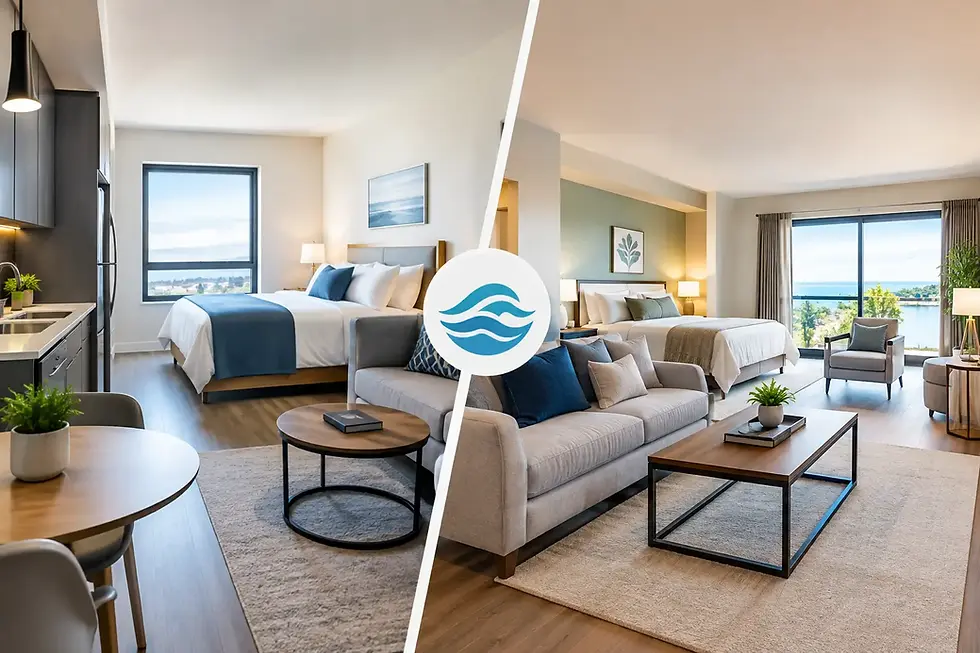
Studio or One Bedroom Stay: Which Fits?

You feel the difference on day two of a surf trip, not day one. Day one is all stoke, boards, warm water, and checking the forecast. By day two, your room setup starts to matter. If you're deciding on a studio or one bedroom stay, the real question is simple: how much space do you actually need to sleep well, store gear, eat easily, and keep the trip affordable?
For surf travelers, that choice is less about square footage on paper and more about how you move through the day. Are you out early, back sandy, rinsing gear, grabbing food, resting, and heading out again? Or are you working remotely between sessions, traveling as a couple, or staying long enough that a little separation starts to feel necessary? The best fit depends on your routine, your budget, and who you're traveling with.
When a studio or one bedroom stay makes sense
A studio works best when the apartment is mainly your basecamp. You want a clean, practical place to sleep, shower, make simple meals, and head back to the beach without paying for extra space you won't use. For solo surfers, short stays, and budget-focused trips, a studio often covers everything that matters.
A one-bedroom apartment starts to make more sense when your stay has more moving parts. Maybe you're traveling as a couple and want one person to sleep while the other reads or works. Maybe you're staying longer and don't want your bed, bags, boards, and kitchen area all in one shared zone. That extra room can change how comfortable the trip feels, especially after a few days.
Neither option is automatically better. A studio can feel efficient and easy. A one-bedroom can feel more comfortable and flexible. The right answer depends on how lightly you travel and how much time you actually spend inside.
Space matters more on a surf trip than people expect
Surf travel comes with extra gear and extra routine. Even if you're renting a board locally, you still have wet clothes, towels, reef-safe sunscreen, bags, maybe a laptop, and the usual travel clutter. In a studio, everything shares one open space, so staying organized matters more. If you're the kind of traveler who keeps things simple, that's rarely a problem.
If you like more separation between living and sleeping, a one-bedroom helps immediately. It gives you a place to put your things without feeling like your whole trip is piled around the bed. For couples, that matters even more. Sharing a compact space can be easy for a weekend and less easy for ten nights.
This is where trip length changes the decision. For a quick surf trip, many travelers are happy to trade extra space for lower cost. For a longer stay, comfort starts to carry more weight. What feels compact for three nights can feel cramped for two weeks.
Budget: where a studio usually wins
If price is the main filter, a studio usually has the advantage. You're paying for what you need and skipping extra room you may barely use. For solo travelers and couples trying to keep the trip economical, that's often the smartest move.
That said, cheaper is not always better value. If a one-bedroom helps you stay longer, cook more easily, work more comfortably, or split the cost with another person, the math can shift. A slightly higher nightly rate may feel worth it if the stay functions better for your actual routine.
This is especially true for travelers balancing surf time with remote work or longer vacations. When the apartment has to do more than provide a bed, the value of extra separation becomes easier to justify.
Privacy and sleep are the real dividing line
The biggest difference in a studio or one bedroom stay is privacy. In a studio, everyone shares the same main area all the time. If one person wakes early for dawn patrol and the other wants to sleep in, both people feel it. If one person wants to make coffee, answer emails, or stay up later, there isn't much separation.
In a one-bedroom, routines can overlap with less friction. One person can rest while the other is up. One can work while the other decompresses. That sounds minor when you're booking, but it becomes more important on active trips where sleep affects everything from mood to paddle strength.
For solo travelers, privacy usually isn't the issue. For couples and friends, it often is. If you already know you travel well in small spaces, a studio may be perfectly fine. If you need room to spread out or keep different schedules, a one-bedroom is usually the safer choice.
The best option by travel style
Solo surfers
For most solo guests, a studio is the practical winner. It's usually the most economical option, and if your plan is to surf, eat, recharge, and repeat, you may not need anything more. A studio keeps the trip simple.
A one-bedroom can still make sense if you're staying longer, carrying work equipment, or just know you want more breathing room. But for a straightforward surf-focused trip, many solo travelers are happiest keeping it efficient.
Couples
Couples are where the decision gets less obvious. A studio can work very well if you're on a shorter trip, traveling light, and comfortable sharing one compact space. If the goal is a clean, affordable base close to the beach, it does the job.
A one-bedroom usually becomes more appealing for longer stays. It gives you a separate sleeping area, a little more privacy, and a better setup if one person works remotely or keeps a different schedule. For many couples, that extra room helps the stay feel relaxed instead of crowded.
Friends or travel partners
If two friends are sharing, a one-bedroom is often the better fit if privacy matters at all. A studio can save money, but everyone is living in one room. That arrangement works best when the trip is short and both people are easygoing about space.
If one person snores, wakes early, works online, or likes downtime indoors, the one-bedroom is usually worth considering.
Location can matter more than layout
A smaller apartment near the surf can be a better choice than a larger one that adds daily hassle. For many guests, being able to walk to Playa Encuentro in about 10 minutes matters more than having extra square footage. Less commuting means easier dawn sessions, easier mid-day breaks, and less energy spent on logistics.
That changes the way you compare options. If you're choosing between a studio close to the beach and a bigger place farther out, the studio may still be the better surf-trip decision. Convenience has real value when your day revolves around wave conditions.
For that reason, many travelers booking with Waverider Apartments are not looking for oversized vacation rentals. They're looking for practical lodging that supports the rhythm of a surf trip without pushing the budget too hard.
Questions to ask before you book
The easiest way to choose is to picture a normal day on your trip. Are you mostly outside, using the apartment to sleep and reset? A studio is probably enough. Do you need room to work, cook more often, or coexist with another person on a different schedule? A one-bedroom is likely the better call.
It also helps to be honest about your habits. Some travelers are naturally minimalist and barely unpack. Others spread out within an hour. Some couples are comfortable in small spaces for any length of time. Others need a separate room by the third night. Booking gets easier when you choose based on how you actually travel, not on what sounds good in theory.
There is also the simple issue of trip mood. If your goal is maximum surf time on a lean budget, a studio often fits perfectly. If your goal is a more comfortable home base with a little separation and flexibility, one bedroom usually earns its keep.
A good stay should match the trip you're taking, not just the price you're seeing. If you choose with your routine in mind, you'll end up with a place that supports the sessions, the downtime, and everything in between.


Comments